VO₂max is the single best number we have for the size of your aerobic engine, and it is one of the strongest known predictors of long-term health. The VO₂max Lab, part of Pro, treats it that way: not a static reading buried in Apple Health, but a trajectory you can measure, test, forecast and train.
The trajectory
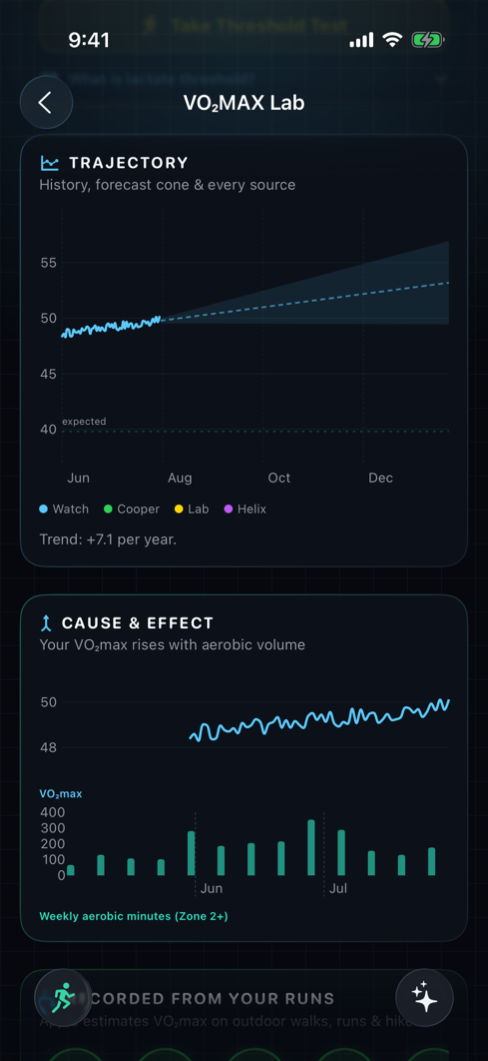
The Lab starts with every VO₂max reading in your history and fits a trend through them: where your engine has been, where it is now, and where it is heading if nothing changes. The forecast is drawn as a cone that widens the further out it goes, because a projection three months ahead is honestly less certain than one three weeks ahead. Set a goal number and the Lab shows an estimated arrival date on your current slope, which updates as new readings land.
Testing your engine directly
Watch estimates are useful but indirect. The Lab gives you ways to measure the engine on purpose:
- The Cooper test. A GPS-measured 12-minute maximal run, driven from the watch. Helix guides the effort, measures the distance, and scores the result automatically when the time is up. It is the classic field test for aerobic capacity, and our Cooper test guide covers how to run one well.
- Guided 4x4 intervals. Four hard work bouts with recoveries between them, paced and timed from the wrist. This is the workout structure with the strongest track record for actually raising VO₂max, so the Lab does not just measure your engine, it hands you the tool for growing it.
- Lab-result uploads. If you have done a real metabolic cart test in a physiology lab, bring the number in. A measured value anchors your trajectory to ground truth.
Lactate threshold
Alongside the engine’s size, the Lab estimates where it starts to redline. During sustained running efforts, heart rate and pace normally move together; past a certain intensity, heart rate starts climbing out of proportion to pace. Helix looks for that deflection point in your workout data and reads it as your lactate threshold, the effort you can hold before fatigue accelerates. No blood draws, no lab visit.
Race predictions
From your current fitness the Lab predicts finishing times across standard race distances, built on established running equivalency methods that map aerobic capacity to sustainable race pace. The predictions assume the distance-specific training is in your legs; a marathon prediction is a fitness statement, not a substitute for long runs.
Context and personalization
Two more instruments round out the Lab. A distribution view places your VO₂max against people of your age and sex, so the number gets context beyond your own history. And your maximum heart rate, which underpins zone and threshold work, is personalized: Helix starts from the standard age-based estimate and raises it when your workouts show credible higher maxima. If you have hit 192 in real efforts, Helix will not pretend your ceiling is 183.
The instruments at a glance
| Instrument | What it answers |
|---|---|
| Trajectory & forecast cone | Where is my engine heading, and when do I reach my goal? |
| Cooper test | What is my aerobic capacity, measured today? |
| Guided 4x4 intervals | How do I actually raise it? |
| Lab-result upload | How does my estimate compare to a measured value? |
| Lactate threshold | What effort can I hold before I redline? |
| Race predictions | What could I run a 5K, 10K or marathon in? |
| Distribution vs. age & sex | Where do I stand among people like me? |
| Personalized max HR | What is my real ceiling, not the textbook one? |
The tests themselves run from the wrist; the watch app page covers the test drivers. Hard interval days also show up as load, so keep an eye on your strain ceiling when you schedule them.