You wore the watch to bed, permissions are granted, and you just woke up. Here is what Helix shows you, what it means on day one, and what it does not mean yet.
What you wake up to
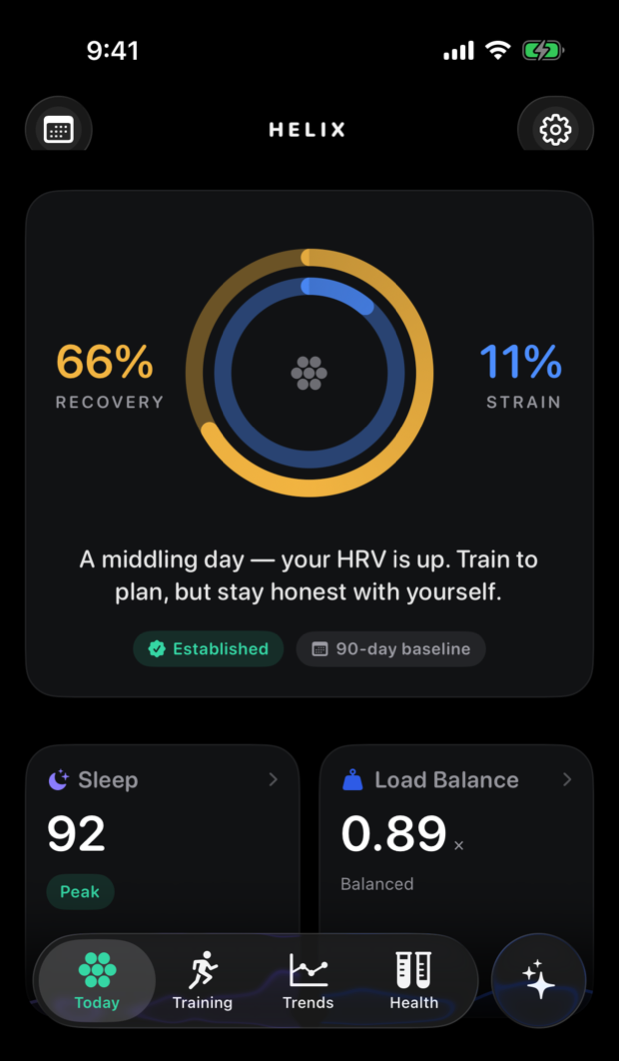
After your first tracked night, the Today screen shows three things:
- A recovery score from 0 to 100, built from your overnight vitals and last night’s sleep, with a visible confidence indicator attached.
- A verdict in plain language: what your body can handle today, and why.
- A strain ceiling: how much training load is sensible today, set by the recovery score. It fills through the day as you move and train.
What day one actually means
Be honest with yourself about what a first score is: your night, compared against a baseline built from almost no history. Helix scores you against your own rolling normal, and on day one that normal is one night deep. The score still points in the right direction, because overnight vitals carry real information on their own. It is just built on a thin foundation, and the app says so.
That is what the confidence indicator is for. It strengthens quickly over your first days as the baseline window fills, and the score keeps personalizing over the following weeks as Helix learns which signals actually track your good and bad days. Full calibration is a matter of weeks and months, not mornings, but the useful part arrives fast: by the end of the first week the score is already grounded in a real sample of you. The baselines & confidence page explains the whole calibration arc.
What to do in week one
The first week is about feeding the baseline, and none of it is complicated:
- Wear the watch to sleep. Every night of vitals is a night of baseline. Nights without the watch are nights Helix cannot learn from.
- Charge before bed, not overnight. A watch on the charger records nothing. Twenty minutes while you wind down is usually enough to get through the night.
- Train normally. Do not stage a special week for the app. Helix is learning what your ordinary life looks like, so give it your ordinary life: hard days, easy days, the rest day you were going to take anyway.
- Rate your days when asked. When Helix asks how a day felt, answer honestly. That feedback is compared against the morning’s inputs and gradually re-weights them, so the signals that predict your days count for more. It is the single highest-leverage thing you can do to make the score yours.
What not to do
- Don’t compare your score to a friend’s. Your 74 and their 74 are measured against two different bodies. Helix never scores you against population averages, so cross-person comparisons are not just unhelpful, they are meaningless by design.
- Don’t panic over one red morning. A single low score early on is one data point against a young baseline. It is a reason to keep the day honest, not evidence that something is wrong. Patterns matter; single mornings mostly don’t.
From here
The daily loop is now running: score in the morning, ceiling through the day, night feeds the next morning. Everything else in Helix builds on it. When you are curious why the score behaves the way it does, start with the recovery score and baselines & confidence.