Most health advice is population advice: a protocol that works on average, tested on people who are not you. Experiments, part of Pro, runs the experiment that actually matters, the one with a sample size of one. You.
How an experiment works
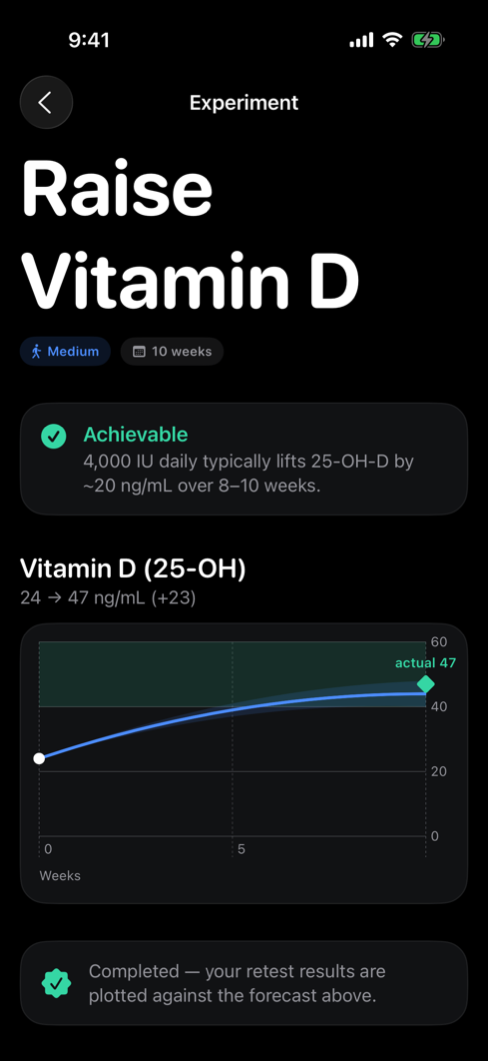
Pick a marker you want to improve, usually one your latest Bloodwork panel flagged. Helix designs a protocol for it, predicts the response curve you should see if the protocol works on your body, and then tracks whether your data follows the prediction. At the end you retest, and the experiment gives its verdict: your marker moved, or it did not.
The point is personal causality. A supplement that moves ferritin on average may do nothing for you; a sleep intervention that barely registers in studies might be exactly what your resting heart rate was waiting for. Population statistics cannot tell you which camp you are in. A well-run N-of-1 experiment can.
What a good experiment needs from you
- Consistency through the window. A protocol followed on the good days and skipped on the busy ones tests nothing. If life blows the window up, better to abandon and restart than to grade a protocol you did not actually run.
- Honest logging. Record what you actually did, including the missed days. Helix can account for imperfect adherence it knows about; it cannot account for adherence you invented.
- A retest at the end. The closing measurement is the whole answer. An experiment without a retest is a hopeful guess with extra steps.
Where the data comes from
Experiments sits on top of two other parts of Helix. Markers and their history come from Bloodwork, which is why repeated panels matter: the before and after measurements of an experiment are just panel uploads. And the behavior journal is the natural place to log the protocol itself; its own N-of-1 analysis catches effects on your daily scores even outside a formal experiment. The journal page covers how that works.
One at a time
The classic N-of-1 mistake is changing three things at once and crediting whichever you liked most. Run one protocol per marker at a time. Slower, but at the end you know something true about your own body, which is the entire point.