Sleep is the biggest single input to how recovered you wake up, so Helix treats it as a first-class feature, not a footnote. Every night gets a full readout: stages, efficiency, latency, how the night stacks against your personal need, and how consistent your timing has been. Sleep is part of the free core loop Free.
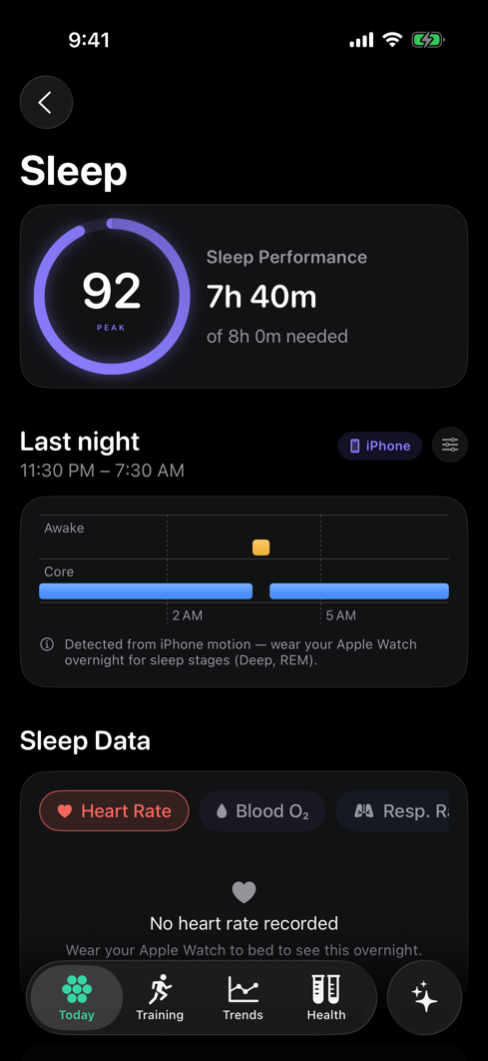
Stages, efficiency, latency
With an Apple Watch worn overnight, Helix reads the stage data your watch records: core, deep and REM sleep, plus the awake gaps between them. On top of the stages it shows:
- Efficiency. How much of your time in bed you actually spent asleep. A long night full of wake-ups can be worth less than a shorter, solid one.
- Latency. How long it took you to fall asleep once you were in bed. Rising latency is often the first visible sign that caffeine timing, late training or stress is creeping into your nights.
Sleep debt vs your need
Helix tracks a 7-day sleep debt: the running gap between the sleep you got and the sleep you personally need. The need is yours, built from your own history, not a population-wide eight-hour rule. One short night barely moves it; a week of shaving 40 minutes shows up as a debt you can see and pay down.
Sleep Regularity Index
The Sleep Regularity Index (SRI) measures how consistent your sleep and wake timing is from day to day. Going to bed at 11pm every night scores high; alternating between 10pm and 2am scores low, even if both patterns average the same hours.
It earns its place next to duration because research keeps finding that regularity predicts how people feel and function almost as strongly as how long they slept. Your body runs on anticipation: hormones, temperature and alertness are scheduled in advance around when it expects you to sleep. Erratic timing means your body is constantly guessing, and you feel it even after a full night.
Nights without the watch
Forgot the watch, or left it charging? Helix falls back to iPhone motion detection for that night. The fallback records duration and timing only, no stages, and it is labeled as an estimate wherever it appears. You keep an unbroken sleep history without Helix pretending it saw stage data it never had. The with & without a watch page has the full breakdown.
What sleep feeds
| Feeds into | How |
|---|---|
| Recovery score | Last night’s duration, structure and debt are among the biggest inputs to the morning score |
| Sleep-anchored day | Your main sleep defines when the day rolls over: wake-up, not midnight |
| Strain | The strain day starts at wake, so the ceiling covers exactly the day your sleep set up |
When a night is missing
No sleep data at all, from watch or phone, means no sleep readout for that night; Helix does not invent one. The usual causes are sleep tracking turned off in the Watch app or missing Health permissions. The troubleshooting page walks the checks in order.