A lab panel is some of the highest-value health data you will ever collect, and it usually arrives as a PDF you skim once and never open again. Bloodwork, part of Pro, turns that PDF into something an athlete can actually use: every marker scored, grouped by body system, and read through the lens of what it means for your training.
Upload a panel
Bring a panel in as a PDF, a photo of the printed report, or a CSV. Helix extracts the markers, their values and their units, and asks you to confirm anything ambiguous rather than guessing silently.
To get a clean extraction on the first pass:
- Photograph the whole page, flat and well lit, not a cropped corner.
- Make sure the units column is visible. A value without its unit is uninterpretable, and Helix will not invent one.
- Upload every page of a multi-page panel; markers you skip are markers Helix cannot score.
How markers are scored
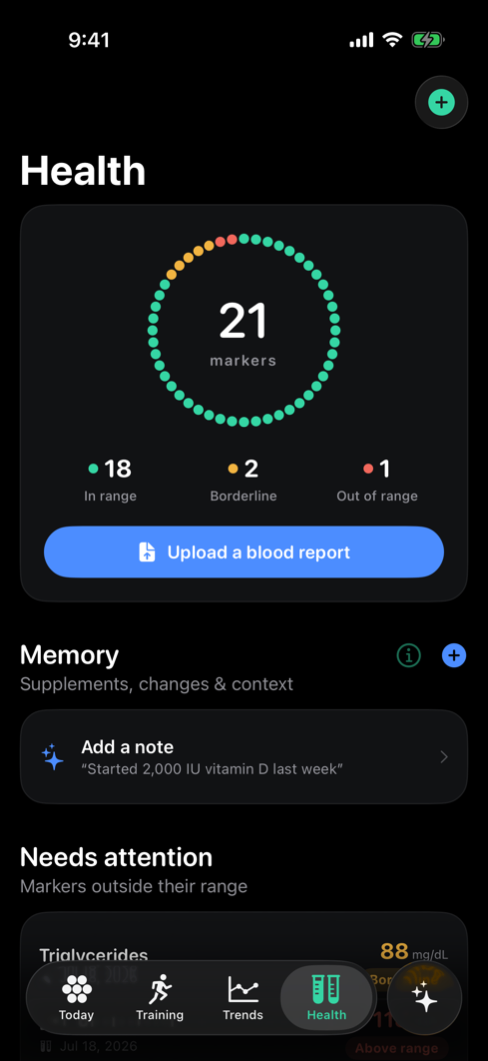
Every marker is scored against age- and sex-specific ranges, not the one-size-fits-all reference interval printed on the report. That includes the niche longevity markers that most apps ignore: if it is on your panel, it gets scored. Each marker carries a status chip, In range, Borderline or Out of range, so the state of a whole panel is readable at a glance.
Markers are grouped by body system, so related signals sit together: the picture of your metabolic health, your lipids, your hormones or your inflammation is one screen, not forty alphabetized rows.
The Athletic Recovery lens
A subset of markers directly shapes how you train and recover, and Bloodwork pulls them into a dedicated Athletic Recovery view. Iron status affects endurance. Vitamin D and magnesium touch sleep and muscle function. Inflammation markers speak to how well you are absorbing training load. This lens answers the athlete’s question, “is anything in my blood holding my training back?”, without making you learn the full panel first.
Panels become trends
One panel is a snapshot; repeated panels are a story. Each upload adds to your history per marker, so you can watch ferritin climb after three months of supplementation or confirm that a training block did not move your inflammation. This history is also what powers Experiments: pick a marker you want to move, run a protocol, and retest to see whether your body actually followed.
Reading your results like an athlete
The scored panel tells you where you stand; interpreting it is a skill of its own. Our guide on how to read bloodwork as an athlete walks through the markers that matter most for training, what tends to move them, and the timing traps, like testing the morning after a hard session and mistaking training effects for pathology.