Every morning Helix gives you one number from 0 to 100 and a plain-language verdict. Green means your body is ready to be pushed. Red means the smartest training decision today is restraint. The score exists to answer a single question before you decide what to do with your day: how much can I actually handle?
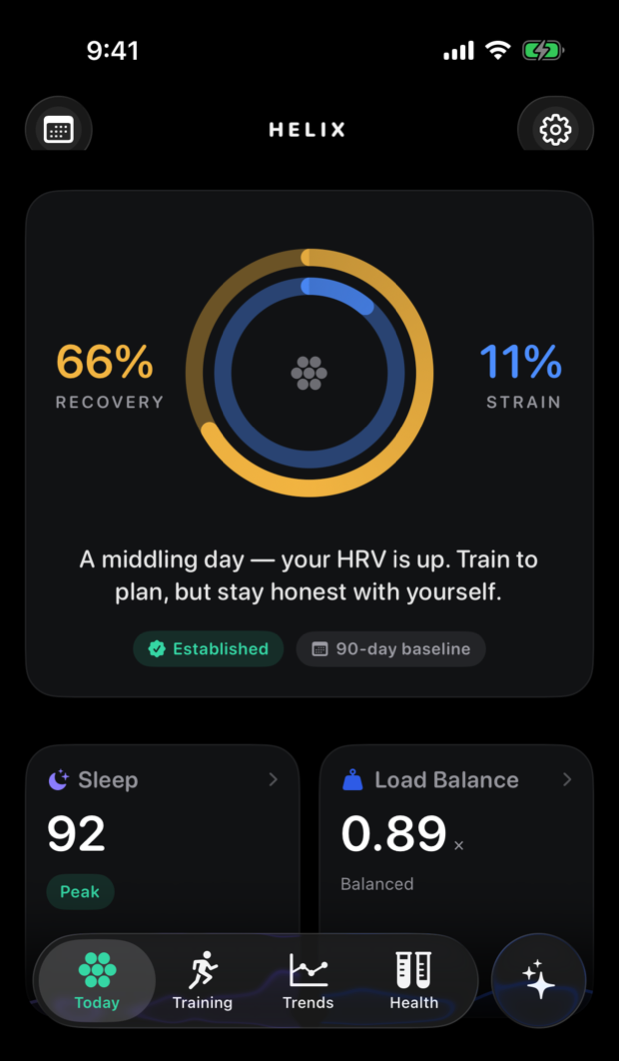
What goes into it
Recovery is built from what your body did overnight, read from Apple Health:
- Heart rate variability, taken from your sleep window rather than a single spot reading, because overnight values are far more stable than daytime ones.
- Resting heart rate, one of the clearest signals of accumulating fatigue or oncoming illness.
- Respiratory rate, which is remarkably constant night to night for a given person, so deviations mean something.
- Wrist temperature and blood oxygen, where your watch records them.
- Last night’s sleep: how much you got, how it compares to what you need, and how well it was structured.
Each signal is compared to your own rolling baseline, typically the last two months of you, and the deviations are combined into the score. A resting heart rate of 58 is great news for one person and a red flag for another; the score only ever asks how tonight compares to your normal.
It learns which signals matter for you
When you rate how a day felt, Helix compares that against the morning’s inputs and gradually re-weights them. If your good and bad days track HRV closely but barely care about sleep duration, your score slowly starts to reflect that. This is why two users with identical overnight data can wake to different scores, and why both are right.
The verdict is frozen
Once your night is complete and the score is computed, the morning verdict does not drift as the day goes on. A nap, a stressful meeting or an afternoon walk changes today’s strain, not this morning’s recovery. That freeze is deliberate: a readiness number that keeps moving after you have already made your training decision is a number you stop trusting.
Confidence while Helix learns you
Baselines need history. For roughly your first two weeks the score carries a visible confidence indicator, and it strengthens as your baseline window fills. The score is still useful on day three; it is just honest about being built on three days of you. The baselines & confidence page covers the calibration period in detail.
Reading the score
| Range | Reads as | Sensible day |
|---|---|---|
| 67–100 | Green: recovered | Hard intervals, heavy lifts, long sessions land well |
| 34–66 | Amber: partial | Train, but keep intensity honest; volume over violence |
| 0–33 | Red: compromised | Easy movement, skills work, or an actual rest day |
The score also sets your strain ceiling for the day, so “how hard should I go” gets a number, not a feeling.
When there’s no score
No night of data means no score; Helix will not invent one. The usual causes are the watch charging overnight, sleep tracking turned off, or Health permissions missing. The troubleshooting page walks the checks in order.